HALAL Certification: A Technical Guide for Importers and Distributors
Understanding HALAL Compliance for Global Food Trade
1. Definition and Scope of HALAL Certification
1.1 What is HALAL?
HALAL (Arabic: حلال, literally "permissible" or "lawful") refers to foods, beverages, and products that comply with Islamic dietary law.
These standards are defined by the Quran and Sunnah.
The concept extends beyond the absence of forbidden ingredients.
It encompasses the entire production process, including sourcing, manufacturing, packaging, storage, and transportation.
The core principles of HALAL food production include:
- Prohibition of forbidden substances: No prohibited animal-derived ingredients, intoxicants, carnivorous animals, or their derivatives
- Proper slaughtering methods: Animals must be slaughtered according to Zabiha (Islamic slaughter) standards
- Absence of cross-contamination: No contact with non-HALAL substances at any stage of production
- Traceability: Full chain-of-custody documentation from raw material to finished product
1.2 International Regulatory Framework
HALAL certification is governed by multiple national and international standards bodies:
- OIC/SMIIC Standards: The Standards and Metrology Institute for Islamic Countries (SMIIC), under the Organization of Islamic Cooperation (OIC), develops harmonized HALAL food standards for its 57 member states
- Codex Alimentarius: The FAO/WHO Codex Alimentarius Commission has published guidelines on food hygiene that are widely referenced in HALAL certification
- National certification bodies: Each major importing country maintains its own HALAL certification regime with specific requirements
2. Why HALAL Certification Matters: A Market and Compliance Perspective
2.1 Market Access: The $2 Trillion Global HALAL Economy
The global HALAL food market represents one of the fastest-growing segments of the international food trade, with an estimated market size exceeding USD 2 trillion as of 2025.
Key drivers include:
- A global Muslim population of over 2 billion people
- Rising disposable incomes in the Middle East and Southeast Asia
- Growing awareness of HALAL requirements among consumers and regulators
- Increasing regulatory enforcement of HALAL labeling laws
Without recognized HALAL certification, your food products are effectively barred from entry into most majority-Muslim markets.
2.2 Compliance Risk and Liability
Non-compliance with HALAL regulations can result in severe consequences for you as an importer or distributor:
- Customs detention and rejection: Your shipments may be seized or refused entry at the port of destination
- Product recall and disposal: Non-compliant products must be recalled and properly disposed of
- Certification revocation: Repeated violations can lead to loss of your HALAL certification status
- Legal liability: In some jurisdictions, misrepresentation of HALAL status constitutes a criminal offense
- Reputational damage: Loss of consumer trust can have long-term commercial consequences for your business
The financial impact of a single non-compliant shipment — including product loss, freight charges, storage fees, and legal costs — can far exceed the cost of proper certification and quality assurance.
2.3 Consumer Trust and Brand Equity
In HALAL markets, certification functions as a baseline signal of quality and integrity.
Your customers view recognized HALAL certification as evidence that you respect their religious and dietary requirements.
This translates into:
- Higher brand trust and loyalty for your products
- Premium pricing potential
- Access to retail channels that require HALAL certification as a listing prerequisite
- Competitive differentiation in crowded market categories
3. HALAL Certification Systems: An Overview
3.1 Major National Certification Bodies
Different countries maintain distinct HALAL certification regimes with varying requirements and levels of international recognition:
| Country/Region | Certification Body | Standard/Framework |
|---|---|---|
| Malaysia | JAKIM (Department of Islamic Development Malaysia) | MS 1500:2019 HALAL Food Standard |
| Indonesia | BPJPH (HALAL Product Guarantee Agency) | UU No. 33/2014 HALAL Product Guarantee Law |
| Saudi Arabia | SFDA (Saudi Food and Drug Authority) | SFDA HALAL Food Regulations |
| UAE | ESMA (Emirates Standards and Metrology Authority) | UAE.S GSO 2055-1:2015 |
| GCC States | GSO (Gulf Standardization Organization) | GSO 993:2015 HALAL Food Requirements |
3.2 Certification Mutual Recognition
A key challenge in international HALAL trade is the mutual recognition of certifications between countries.
While some bilateral and multilateral recognition agreements exist, the landscape remains fragmented.
You should verify that your supplier's certification is specifically recognized by the regulatory authority in your destination country.
4. Food Safety Management Systems and HALAL
HALAL certification does not exist in isolation — it is typically implemented alongside internationally recognized food safety management systems.
When you evaluate a supplier, you should look for these common certifications held by reputable HALAL food manufacturers:
4.1 HACCP (Hazard Analysis and Critical Control Points)
HACCP is a systematic preventive approach to food safety.
It identifies physical, chemical, and biological hazards at specific points in the production process.
Developed by NASA in the 1960s, it was later adopted by the Codex Alimentarius Commission.
HACCP is now a global standard for food safety management.
HACCP principles include:
- Conducting hazard analysis
- Identifying critical control points (CCPs)
- Establishing critical limits
- Implementing monitoring procedures
- Establishing corrective actions
- Implementing verification procedures
- Maintaining documentation and record-keeping
4.2 FSSC22000 (Food Safety System Certification 22000)
FSSC22000 is a GFSI-recognized certification scheme for food safety management systems.
It is based on ISO22000.
It includes additional requirements for food safety prerequisite programs (PRPs).
FSSC22000 is widely recognized by major retailers and food manufacturers worldwide.
4.3 ISO9001:2015 Quality Management System
ISO9001:2015 is the international standard for quality management systems.
It provides a framework for organizations to ensure consistent product quality.
It also ensures customer satisfaction through process-based management and continuous improvement.
4.4 ISO14001:2015 Environmental Management System
ISO14001:2015 specifies requirements for an environmental management system.
It helps organizations reduce their environmental impact.
It also helps them comply with applicable environmental regulations.
4.5 Other Relevant Certifications
- KOSHER: Jewish dietary law certification, which shares some commonalities with HALAL requirements
- FDA Registration: Registration with the US Food and Drug Administration for food facilities exporting to the United States
- SEDEX: Supplier Ethical Data Exchange, a membership organization for ethical trade auditing
5. HALAL Compliance: Technical Requirements and Best Practices
5.1 Dedicated Production Lines and Cross-Contamination Prevention
Cross-contamination is the unintentional transfer of non-HALAL substances to HALAL products.
It is one of the most significant risks in HALAL food production.
The gold standard for mitigating this risk is the implementation of dedicated HALAL production facilities.
Key controls you should look for include:
- Physical separation: Separate production lines, equipment, and storage areas for HALAL and non-HALAL products
- Color-coded equipment: Distinctive color coding for HALAL-dedicated tools and utensils
- Cleaning validation: Documented cleaning procedures with verification between non-HALAL and HALAL production runs
- Segregated storage: Separate warehousing for raw materials and finished products
- Personnel training: Staff trained in HALAL requirements and cross-contamination prevention
5.2 Raw Material Sourcing and Supplier Qualification
HALAL compliance begins at the raw material stage.
A robust supplier qualification program should include:
- HALAL certification verification: All raw materials and ingredients must have valid HALAL certification from recognized bodies
- Ingredient declaration review: Full review of all ingredients, including additives, processing aids, and flavorings
- Supplier audit programs: On-site audits of critical suppliers
- Ongoing monitoring: Regular re-verification of supplier certification status
When you audit a supplier, pay special attention to their ingredients sourcing and vendor approval processes.
5.3 Traceability and Chain of Custody
Traceability is the ability to trace a product through all stages of production, processing, and distribution.
It is a fundamental requirement for HALAL certification.
Effective traceability systems enable you to:
- Rapidly identify and recall non-compliant products
- Verify HALAL status at every stage of the supply chain
- Resolve customer complaints and quality issues quickly
- Demonstrate compliance with regulatory requirements
5.4 Third-Party Auditing and Verification
Third-party auditing by independent certification bodies provides objective assurance.
It confirms that HALAL requirements are being met.
Typical audit activities you can expect include:
- Document review (HACCP plans, HALAL procedures, training records)
- On-site inspection of production facilities
- Review of supplier records and traceability systems
- Employee interviews and training verification
- Sampling and laboratory testing (where applicable)
Audits may be scheduled or unannounced, depending on the certification body's requirements.
6. Documentation and Export Requirements
Every shipment of HALAL food products must be accompanied by complete documentation to demonstrate compliance.
The standard documentation set you should expect includes:
| Document | Purpose |
|---|---|
| HALAL Certificate | Official certification issued by the HALAL certification body, confirming that the products meet HALAL requirements |
| Certificate of Analysis (COA) | Laboratory test results confirming product specifications and quality parameters |
| Sanitary / Health Certificate | Government-issued certificate confirming the product is fit for human consumption |
| Certificate of Origin | Document certifying the country of origin of the goods |
| Packing List | Detailed list of contents, including quantities, weights, and packaging specifications |
| Commercial Invoice | Official invoice for the goods |
You should verify that all documentation is complete, accurate, and issued by recognized authorities before your shipment departs the port of origin.
7. Selecting a Reliable HALAL Supplier: A Technical Checklist
When you evaluate potential HALAL food suppliers for your business, you should consider the following technical criteria:
7.1 Certification Credentials
- Valid HALAL certification from a body recognized by your destination market
- FSSC22000, HACCP, and ISO9001 certification
- Current audit reports and certification status
- Scope of certification (which products, which facilities)
- Verification that the certification covers your specific ingredients and product types
7.2 Production Capabilities
- Dedicated HALAL production lines or validated segregation procedures
- Production capacity and lead time that match your order volume requirements
- Product range and formulation capabilities
- OEM/private label capabilities with flexible MOQ options
- Shelf life stability and packaging options
7.3 Quality Assurance Systems
- HACCP plan implementation
- In-house laboratory capabilities for ingredients testing
- Pre-shipment inspection procedures
- Complaint handling and recall procedures
- Traceability system capabilities (batch-level tracking)
7.4 Export Experience
- Track record of exports to your target markets
- Familiarity with destination country regulations
- References from existing customers in the region
- Experience with customs clearance procedures
- Ability to provide FOB, CIF, or CFR incoterms
8. Conclusion: HALAL Compliance as a Strategic Investment
HALAL certification is not merely a regulatory checkbox — it is a strategic investment in your market access, risk mitigation, and brand equity.
For you as an importer or distributor operating in Middle East and Southeast Asian markets, working with suppliers that have robust HALAL compliance systems means:
- Reduced regulatory risk: Lower probability of customs issues or product recalls
- Faster time-to-market: Pre-certified products can enter markets without delay
- Stronger competitive position: Certification provides a clear differentiator for your business
- Greater customer trust: Third-party certification builds credibility with your retailers and consumers
As the global HALAL market continues to grow, the importance of rigorous, technically sound HALAL compliance will only increase.
Importers like you who prioritize working with certified, audited suppliers will be best positioned to capture the opportunities in this dynamic market.
FAQ — HALAL Certification
Q1: What is the difference between HALAL certification and HACCP?
HALAL certification verifies compliance with Islamic dietary law.
HACCP (Hazard Analysis and Critical Control Points) is a food safety management system.
It focuses on preventing physical, chemical, and biological hazards.
Both are complementary: HACCP ensures food safety, while HALAL certification ensures compliance with religious dietary requirements.
Q2: Are all HALAL certifications mutually recognized between countries?
No. While some bilateral and multilateral recognition agreements exist, the HALAL certification landscape remains fragmented. Importers should verify that their supplier's certification is specifically recognized by the regulatory authority in the destination country.
Q3: What is cross-contamination, and how is it prevented?
Cross-contamination is the unintentional transfer of non-HALAL substances to HALAL products.
It is prevented through dedicated production lines.
It also requires physical separation of equipment and storage.
Other measures include validated cleaning procedures, color-coded tools, and staff training.
Q4: What documentation is required for HALAL food imports?
Standard documentation includes:
- Original HALAL certificate
- Certificate of Analysis (COA)
- Sanitary/health certificate
- Certificate of origin
- Packing list
- Commercial invoice
Specific requirements may vary by destination country.
Q5: How often are HALAL facilities audited?
Audit frequency varies by certification body.
Most reputable certification bodies conduct scheduled audits at least annually.
Additional unannounced audits may be conducted for higher-risk facilities.
About Our HALAL Certification Program
At Blue Coral Food, HALAL compliance is not an afterthought. It is the foundation of everything we do.
Our Partner Factories
We work exclusively with manufacturers that hold internationally recognized HALAL certifications and have proven export track records:
| Partner | Location | Specialization | Key Certifications |
|---|---|---|---|
| President Kikkoman Zhenji | Shijiazhuang | Brewed soy sauce, vinegar, rice cooking sauce (180-day natural brewing) | HALAL, FSSC22000, ISO9001, ISO14001, Non-GMO |
| Qingdao Tianri | Qingdao | Himalayan salt grinders, sea salt, seasoned salts (40+ SKUs) | HALAL, HACCP, KOSHER, FDA |
| Baopu Flavor | Jinan | HALAL compound seasoning pastes, hotpot bases, dipping sauces (1,000+ formulas) | HALAL, HACCP, dedicated HALAL facility |
| Tuodong Flavor | Kunming | Specialty sauces, sweet soy sauce (est. 1684, 340+ years heritage) | HALAL, FSSC22000, ISO9001 |
We partner with a large network of HALAL-certified factories across China. Due to space limitations, only our key partners are listed above. Contact us for the full factory list and capabilities.
Our Certifications
All partner facilities collectively hold the following international certifications:
| Certification | Scope |
|---|---|
| HALAL | International HALAL food certification (recognized across Middle East & Southeast Asia) |
| FSSC22000 | Food safety system certification |
| ISO9001 | Quality management system |
| ISO14001 | Environmental management system |
| HACCP | Hazard analysis and critical control points |
| KOSHER | Jewish food certification (Union-K) |
| FDA | US Food and Drug Administration registered |
| SEDEX | Ethical trade audit by SGS |
| Non-GMO | Identity preserved status |
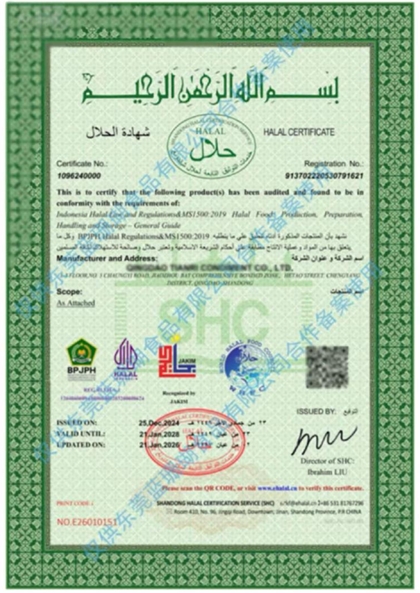
HALAL Certificate Sample
Below is a sample of an international HALAL certificate held by one of our partner factories, issued by a recognized certification body:
Markets We Serve
Our HALAL-certified products are exported to and recognized across:
- GCC countries: Saudi Arabia, UAE, Qatar, Kuwait, Bahrain, Oman
- Southeast Asia: Malaysia, Indonesia, Brunei, Singapore
- Other HALAL markets: Worldwide demand from Muslim consumers
Our HALAL Compliance Commitment
We maintain strict HALAL compliance at every stage:
- Dedicated HALAL production lines at Baopu facility (100% HALAL-only factory, zero cross-contamination risk)
- Rigorous raw material sourcing with full HALAL certification verification for every ingredient
- Complete traceability from raw material to finished product, with batch-level tracking
- Regular third-party audits by independent certification bodies
- Full documentation per shipment: HALAL certificate, COA, sanitary certificate, certificate of origin, packing list, and commercial invoice
What You Get
When you source HALAL products from Blue Coral Food, you receive:
- Complete HALAL documentation with every container
- Pre-shipment inspection reports with photos
- Certificate copies available for verification at any time
- Dedicated support for customs clearance at destination
- A single point of contact for all HALAL compliance questions
Request Certification Documentation
To learn more about our certified HALAL product range, request samples, or obtain copies of our current HALAL certificates and audit reports, contact us today.
Email: [email protected]
WhatsApp: +86 18926532490
All HALAL certifications are issued by recognized certification bodies and are subject to regular audits. Copies of current certificates and audit reports are available upon request.
Request Certification Documentation